
840-900 Double Layer Roll Forming Machine: Two Profiles, One Frame, Half the Floor Space
writer:优化 release time:2026-10-10 20:55:06 Views:99frequency
Deciding between two single-profile machines and one 840-900 double layer roll forming machine is rarely a question of capability. Both routes make the same panels. The real question is which route leaves you with the lower cost per tonne of saleable sheet once floor space, labour, coil handling and changeover time are counted. For distributors and contractors whose market stocks both the 840 and the 900 profile, the double layer frame usually wins on every line of the calculation.
The 840 and 900 geometries are regional standards across Africa, Central Asia, South America and Southeast Asia. Distributors who stock only one of them lose orders to competitors who stock both. The engineering challenge is producing both, accurately, without paying for two frames, two drives and two footprints.
What a Double Layer Frame Actually Does
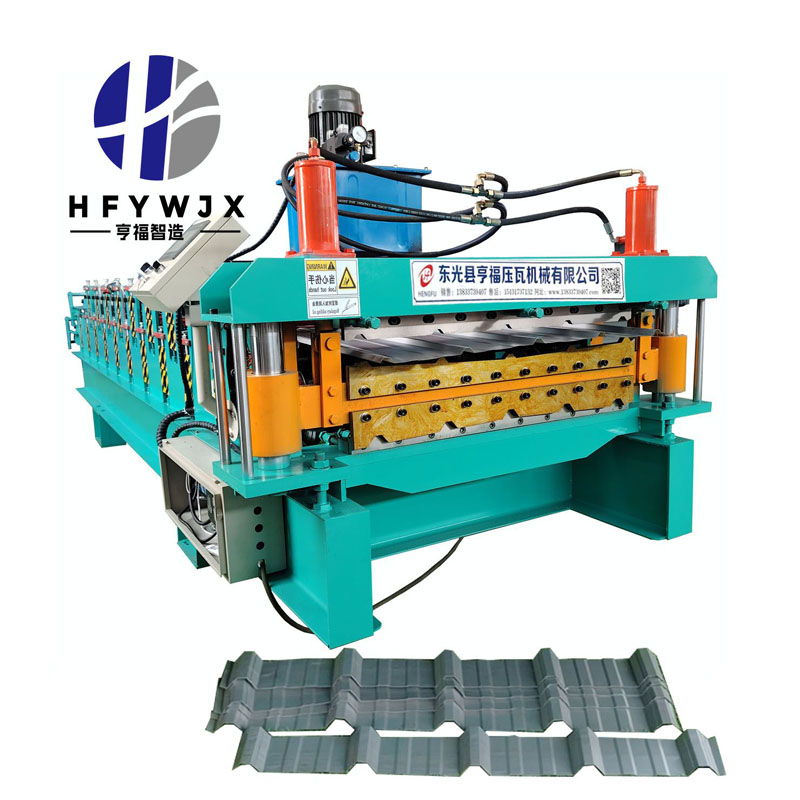
A double layer machine stacks two independent forming sections vertically in one frame: an upper set and a lower set. The operator selects which level runs via a clutch or a conversion button on the floor control pendant. Strip feeds into the active level; the idle level is simply bypassed. Because the frame, drive and control system are shared, the second profile costs roughly the price of a roller set rather than the price of a machine.
Typical Hengfu specification for the 840/900 configuration:
| Item | Specification |
|---|---|
| External dimensions | 6500 × 1300 × 1200 mm (compact layout approx. 5700 × 1500 × 1500 mm) |
| Machine frame | 300H steel frame, 14 mm middle plates |
| Forming stations | V900 upper: 10 pre-forming rows | V840 lower: 11 pre-forming rows (13-row upper variant available) |
| Main shaft | Φ70 mm solid shaft |
| Drive | Chain drive, 7.5 kW main motor |
| Forming speed | 0–35 m/min (0–12 m/min in typical production) |
| Material | Galvanised steel and colour steel coil, 1000 mm width, up to 0.6 mm |
| Control | PLC with automatic computer-controlled cut-to-length |
The Space and Labour Argument
The arithmetic is simple but decisive. Two single machines occupy two footprints, need two operators or a walking operator, and require two coil loading positions. One double layer machine occupies one footprint, is run by one operator who never leaves the pendant, and loads coil from one position.
Practical rule: if each profile runs less than a full shift per day, a double layer machine is almost always correct. If both profiles run two full shifts every day, two dedicated lines will out-produce one shared frame and the calculation reverses.
Double layer machines are also the standard answer for on-site manufacturing. A compact frame that ships in one container and produces two profiles lets a contractor fabricate roofing at the job site, eliminating transport damage, long-sheet logistics and the margin a third-party panel supplier would charge.
Core Performance Factors
Roller stations per level — fewer rows on the upper level is normal, but do not accept a design that drops below 10 rows for a trapezoidal profile; the result is visible rib distortion and edge wave.
Shaft diameter — Φ70 mm solid is the working minimum for a stacked frame. Undersized shafts are the most common cause of profile twist on upper-level production.
Changeover logic — a clutch or conversion button must mechanically isolate the idle level. Check that the idle rollers cannot be dragged by the strip.
Cut-to-length control — the PLC must store length and batch settings independently for each level, otherwise operators re-enter numbers on every changeover and errors follow.
Discharge handling — upper-level output discharges at a different height; specify a run-out table that suits both levels or an adjustable receiving rack.
840 vs 900: Where Each Profile Sells
| Profile | Geometry | Typical use | Market note |
|---|---|---|---|
| 840 | Trapezoidal rib, narrower cover width | Residential roofing, small commercial buildings, wall cladding | High-volume standard in many export markets; frequently paired with a glazed tile upper level as an 840/900 glazed combination |
| 900 | Trapezoidal rib, wider cover width | Industrial sheds, warehouses, agricultural buildings | Preferred where wider cover reduces sheet count and fixing cost |
Because cover width differs, the same coil weight yields different saleable area per profile. When you model returns, run the calculation in square metres of covered roof, not in tonnes of coil consumed — the answer frequently changes which profile deserves the upper level.
Double Layer vs Two Single Lines
| Factor | Double layer 840/900 | Two single machines |
|---|---|---|
| Capital cost | Lower — one frame, one drive, one control | Higher — roughly 1.6–1.9× |
| Floor space | One footprint | Two footprints plus access aisles |
| Labour | One operator | One to two operators |
| Throughput | One profile at a time | Two profiles simultaneously |
| Changeover | Seconds via clutch / conversion button | Walk to the other machine |
| Best for | Distributors, contractors, on-site fabrication | High-volume plants running both profiles continuously |
What to Specify Before Ordering
Confirm these five points and the machine will commission without surprises:
Which profile sits on the upper level — decide from your volume mix, not from habit.
Roller row count and roll material (45# steel, rough turned, fine turned, outer-circle ground and plated).
Whether you need ordinary or hydraulic unloading, and whether an automatic stacker is in scope.
Motor power and electrical standard for your country, including 60 Hz variants.
Customisation of both levels — Hengfu builds upper and lower profiles to customer drawings.
Maintenance Notes Specific to Stacked Frames
Stacked frames concentrate load in the middle plate, so inspect middle-plate fasteners and shaft bearings on the upper level on a tighter interval than on a single machine. Lubricate both levels' chains even when the upper level has been idle for weeks — idle chains corrode faster than running ones. Keep a spare encoder and a spare blade set; both are inexpensive relative to a stopped line during roofing season.
Future Trends
The next generation of double layer machines is moving to servo-driven cut-to-length and automatic stackers, which together remove the last manual step between forming and bundling. Frequency conversion control is becoming standard rather than optional, because soft starting extends chain and gearbox life materially. Expect also to see more mixed-purpose combinations — a trapezoidal level paired with a glazed tile or corrugated level — as distributors try to cover three market profiles with one frame.
Frequently Asked Questions
Q: Can both layers run at the same time?
No. A double layer machine runs one level at a time, selected by clutch or conversion button. It is designed for flexibility and space saving rather than simultaneous output.
Q: What coil width and thickness does the 840/900 machine accept?
Standard specification is up to 1000 mm coil width and up to 0.6 mm thickness in galvanised or colour steel. Heavier gauges can be engineered with additional forming stations and higher motor power.
Q: How fast can it produce?
The mechanical range is 0-35 m/min, with typical stable production around 10-12 m/min. Real output depends on operator practice, coil quality and whether an automatic stacker is fitted.
Q: Is customisation available on both levels?
Yes. Both the upper and the lower profile can be built to customer drawings, and unloading can be specified as ordinary or hydraulic.
Q: Is a double layer machine suitable for on-site jobs?
Yes. The compact 5700-6500 mm footprint fits a single container and is a common choice for contractors fabricating roofing directly at the construction site.
Talk to the Hengfu Engineering Team
Dongguang County Hengfu Roll Forming Machinery Co., Ltd. designs and builds roll forming lines in Cangzhou, Hebei — from standalone tile machines to complete automated production lines. Every line is delivered with design, production, installation, commissioning and lifetime technical support.
Profile drawing → roller design → trial production → shipment → on-site commissioning.
Request a Quote & Profile Design