
High Altitude Standing Seam Roll Forming Machine 760: On-Site Roofing at 30 Metres
writer:优化 release time:2026-10-13 21:26:38 Views:188frequency
Buying a high altitude standing seam roll forming machine is rarely about the machine in isolation. It is about eliminating the three costs that quietly dominate large metal roofing projects: crane time, transport damage, and the maximum panel length a truck can legally carry. For contractors building warehouses, logistics parks and industrial plants, producing the panel at 30 metres and sliding it straight onto the purlins changes the economics of the entire roof package.
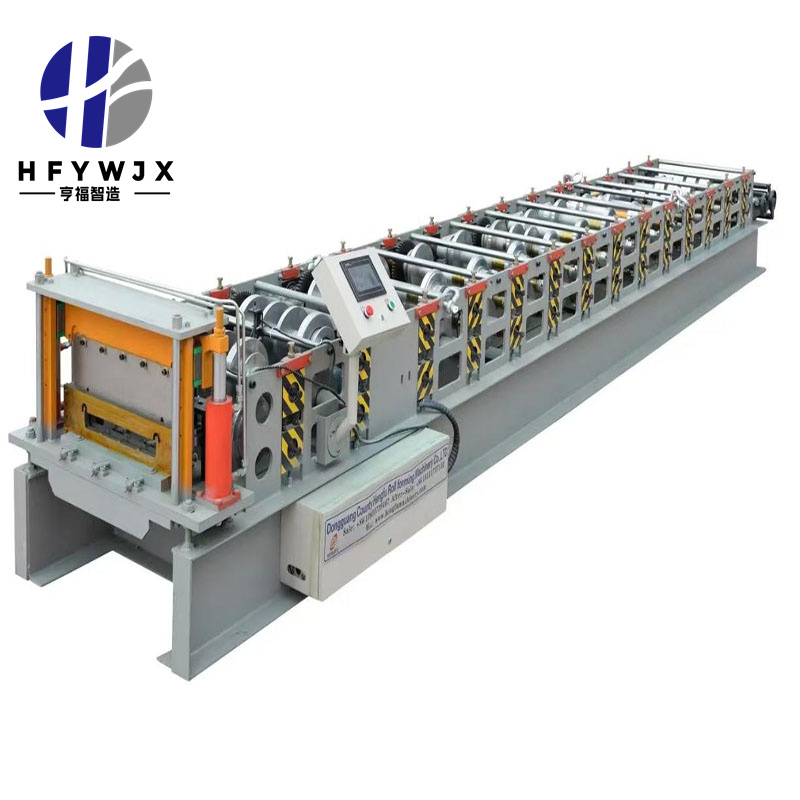
The 760 standing seam profile is the workhorse of this method. Its concealed-fix seam is weathertight at low pitch, and because the panel is formed continuously, a single sheet can run the full ridge-to-eave length with no end lap — the single biggest source of leakage in conventional screw-fixed roofing.
Why On-Site Forming Beats Factory-Delivered Panels
Conventional practice is to form panels at a factory, truck them to site, crane them to the roof, and lap them where length runs out. Each step adds cost and risk:
Transport length limits force end laps on long roofs; every lap is a potential leak path.
Handling damage to pre-painted coil is the most common cause of rejected panels on site.
Crane hire is billed by the hour and is weather-dependent.
Storage area for long panels consumes yard space that most sites do not have.
An aerial-platform-mounted roll former removes all four. Coil arrives in compact rolls, is formed at the working height, and is fed directly along the purlin line. Panels are cut to exact length on demand, so offcut waste approaches zero.
Key point: the economics are strongest on roofs longer than about 40 metres and on sites where crane access is difficult. On small roofs with easy access, factory-formed panels remain cheaper.
How the 760 Profile Is Formed at Height
A high altitude system pairs a compact roll forming head with a telescopic aerial work platform. The platform lifts the forming head and operator to the eave or ridge height — Hengfu offers 18.5 m, 24 m, 31 m and 34 m configurations — while coil is fed from ground level or from a decoiler mounted on the platform chassis. The forming head progressively bends the strip through its passes and extrudes finished panel directly onto the roof plane.
Hengfu's high-altitude machines and 430 ridge-cap equipment share the same modular architecture: loading rack, loading rack support, feed introduction platform, forming host, and forming-and-shearing device. The 430 variant is commonly specified in aluminium-magnesium-manganese for architectural standing seam roofs, using a 350H frame, 14 forming rows, Φ70 mm solid shaft, 600 mm feed width and 1.2-inch quenched chain drive with three-blade linear guide cutting.
Core Performance Factors
| Factor | Why it decides project outcome |
|---|---|
| Platform height and stability | Must exceed ridge height with margin; outrigger footprint must suit site ground conditions |
| Profile accuracy at height | Seam engagement depends on tight rib geometry; a drifted seam will not clip or will unzip in wind uplift |
| Feed synchronisation | Ground-fed coil must track the platform without dragging or kinking the strip |
| Cut-to-length control | PLC encoder control keeps panel length accurate so ridge and eave details fit first time |
| Material compatibility | Aluminium-magnesium-manganese, galvanised and colour steel require different roll finishes and clearances |
| Wind policy | Platform work stops above defined wind speeds; schedule critical roof areas around seasonal weather |
Standing Seam vs Screw-Fixed Roofing
| Factor | 760 standing seam | Screw-fixed trapezoidal |
|---|---|---|
| Weather tightness | Concealed clip, no through fasteners | Fastener holes are inherent leak paths |
| Thermal movement | Clips allow the panel to slide | Fixed fasteners fight thermal cycling and elongate holes |
| Minimum pitch | Works at very low pitch | Needs more pitch to shed water at laps |
| Installation speed | Fast once the crew is trained | Faster for small, simple roofs |
| Skill requirement | Higher — seaming tool and clip setting | Lower |
Applications Where High Altitude Forming Wins
Logistics warehouses and distribution centres — long, repetitive roofs where continuous panels remove hundreds of end laps.
Industrial plants with restricted access — where crane positioning is impossible between buildings.
Airport hangars and exhibition halls — very long spans where transport length is prohibitive.
Remote sites — where the nearest panel factory is a day's trucking away.
Retrofit over-roofing — where new panels must be formed and laid without stripping the old roof first.
What to Specify Before Ordering
Specify these six items before the platform is built:
Ridge height and required platform model — 18.5 / 24 / 31 / 34 m.
Profile drawing — 760 standing seam, or 430 hidden-clip for architectural work.
Material and thickness — aluminium-magnesium-manganese, galvanised or colour steel.
Seaming method — mechanical field seamer specification and who supplies it.
Site power supply and whether a generator is needed.
Commissioning scope — on-site training for the platform and the former.
Safety and Operating Discipline
High altitude forming is a lifting operation as much as a forming operation. Establish an exclusion zone beneath the platform, enforce wind limits, and never allow the forming head to run while personnel are below the discharge point. Inspect wire ropes, outriggers and the platform levelling system daily — the forming equipment is reliable, but the lift system is what determines whether the crew goes home.
Future Trends
Two developments are worth watching. Lighter forming heads are extending the reach of smaller platforms, which brings on-site forming within budget for mid-size contractors. And digital length control linked to the building model now lets a roof be produced panel-by-panel against the design, reducing cutting waste to near zero on complex geometries.
Frequently Asked Questions
Q: What heights are available?
Hengfu aerial work platforms are offered at 18.5 m, 24 m, 31 m and 34 m, covering most industrial and logistics building ridge heights.
Q: Which profiles can be produced at height?
The 760 high altitude standing seam profile is the standard configuration. The 430 joint hidden standing seam machine is used for architectural roofs, and ridge cap profiles are produced by companion equipment.
Q: What materials can be formed on site?
Galvanised steel, colour-coated steel and aluminium-magnesium-manganese coil, subject to thickness and to the roll clearance specified for the machine.
Q: Does on-site forming really eliminate end laps?
Yes, for ridges within the coil length remaining on the decoiler. Panels are cut to exact length on demand, so a roof can be clad ridge-to-eave in one continuous sheet.
Q: Is operator training included?
Hengfu provides installation, commissioning and operator training as part of its one-stop service, including technicians dispatched for on-site commissioning.