

Cable Tray Roll Forming Machine: High-Volume Production of Cable Management Systems
writer:优化 release time:2026-10-22 22:26:29 Views:195frequency
Investing in a cable tray roll forming machine is rarely about entering a new market. It is about escaping the cost structure of press-brake batch production once order volume passes a predictable threshold. For electrical manufacturers supplying data centres, industrial plants and commercial towers, the decision point arrives when bending each tray length by hand costs more in labour than the entire roll formed alternative.
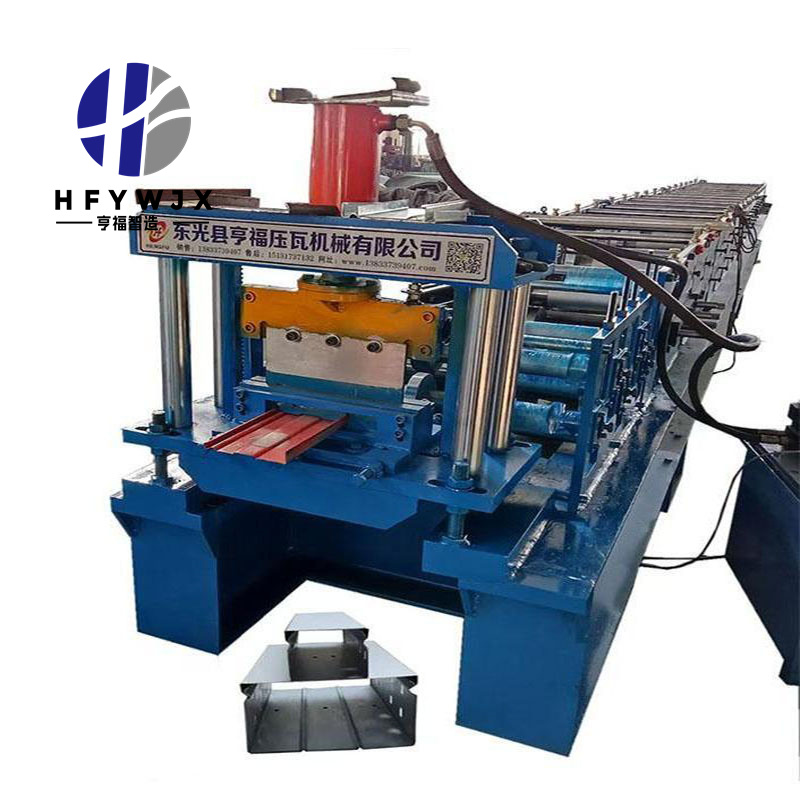
Cable tray is a continuous, standardised, high-volume product — the ideal profile for roll forming. The engineering question is not whether to roll form it, but how to integrate punching, cutting and handling so the line runs unattended for a full shift.
Perforated vs Ladder Cable Tray: Two Production Routes
| Type | Forming route | Line requirement | Typical application |
|---|---|---|---|
| Perforated tray | Roll formed channel with punched slot pattern | Roll former plus hydraulic or servo punching station, often in-line | Data centres, commercial cable management, light-to-medium cable loads |
| Ladder tray | Two roll formed side rails joined to rungs | Rail roll former plus rung forming and a welding or riveting station | Heavy power distribution, industrial plants, long spans |
| Trunking / raceway | Closed profile with return lips | More forming stations, tighter tolerance | Commercial interiors where cable must be fully enclosed |
The highest-volume route, and the one most buyers start with, is the perforated tray: one profile, one punch pattern, continuous output.
Line Configuration: What Actually Sits on the Floor
A complete cable tray making machine line is built from these stations:
Hydraulic decoiler — handles the coil weight typical of 1.5–2.5 mm material.
Leveller and feed — removes coil set so the tray side walls stay square.
Punching unit — hydraulic press or servo punch producing the slot or hole pattern.
Roll forming host — progressive passes form the channel and return lips.
Cut-to-length shear — usually a flying shear for continuous output.
Run-out and stacking — manual or automatic, depending on length and volume.
Design decision: punching can be done off-line on a separate press or in-line ahead of the former. In-line punching costs more but removes a handling step and keeps hole-to-end dimensions accurate.
Core Performance Factors
| Factor | Why it matters for cable tray |
|---|---|
| Material thickness range | Tray is heavier gauge than roofing — typically 1.0–2.5 mm; the frame and drive must be sized for it |
| Hole pattern accuracy | Slot pitch must register with the cut end so trays butt correctly on site |
| Side-wall squareness | Out-of-square walls make covers and couplers impossible to fit |
| Burr control | Burrs on punched slots cut cable insulation — a warranty issue, not a cosmetic one |
| Cut-length tolerance | Standard 2.44 m / 3 m lengths must be exact for coupler fit |
| Speed versus punching | Punch cycle time, not forming speed, usually sets the line rate |
Material and Finish Options
Pre-galvanised steel (GI) — the volume standard for indoor commercial tray.
Hot-dip galvanised after forming — for outdoor and industrial environments; note that forming must precede or follow galvanising according to your process.
Stainless steel 304 / 316 — food, pharmaceutical and coastal projects; requires higher forming force and appropriate roll finish.
Aluminium — where weight matters, such as long-span installations and marine environments.
Specify roll finish carefully: stainless and pre-galvanised surfaces mark easily, and roll scoring is the most common reason finished tray is rejected by distributors.
Roll Forming vs Press Brake Production
| Factor | Roll forming line | Press brake batch production |
|---|---|---|
| Output per shift | Continuous, multiples of brake output | Limited by handling per bend |
| Consistency | Set once, repeatable | Operator dependent |
| Labour per metre | Low | High |
| Flexibility | Low — one profile per roller set | High — any length and angle |
| Capital cost | Higher | Lower |
| Best for | Standard product, sustained volume | Custom sizes, low volume, prototyping |
What to Specify Before Ordering
Specify these seven items and commissioning will be routine:
Tray profile drawing — width, height, return lip, and corner radii.
Material type, thickness range and yield grade.
Hole or slot pattern drawing, and whether punching is in-line or off-line.
Standard finished lengths and cut-length tolerance.
Target output per shift — this drives whether a flying shear is required.
Electrical standard and control brand preference for your market.
Whether automatic stacking is in scope.
Maintenance Notes
Punch tooling dominates maintenance on a tray line. Track punch-to-die clearance and re-grind on a scheduled interval rather than waiting for burrs to appear — by the time burrs are visible, cable has already been damaged. Keep the leveller clean; coil set that reaches the former shows up as wall squareness drift that no downstream adjustment can correct.
Future Trends
Data-centre construction is the strongest demand driver in this segment, and it pulls specification upward: tighter dimensional tolerance, documented load testing, and finishes suitable for inspected environments. Servo punching is replacing hydraulic punching on higher-end lines because it allows slot patterns to be changed without tooling changeover. Buyers should expect project specifications, rather than price, to set the requirements in this market.
Frequently Asked Questions
Q: Can one machine produce both perforated and ladder tray?
The side-rail roll former for ladder tray and the channel former for perforated tray are different roller sets. Many manufacturers run the rail profile on one line and add a rung-forming and joining station separately.
Q: What thickness can a cable tray roll forming machine handle?
Tray is heavier gauge than roofing coil, typically 1.0-2.5 mm. The frame, shaft diameter and motor power must be specified for the top of that range, not the bottom.
Q: Is punching included in the line?
It can be. In-line hydraulic or servo punching ahead of the forming section keeps hole-to-end registration accurate and removes a separate handling step; off-line punching is cheaper but slower.
Q: What finishes can be produced?
Pre-galvanised steel, hot-dip galvanised (before or after forming depending on your process), stainless 304/316 and aluminium, subject to roll finish and forming force specification.
Q: How accurate are finished lengths?
With PLC encoder control and a flying shear, standard lengths such as 2.44 m and 3 m are held within approximately 1 mm, which is what coupler systems require.