

Downspout and Gutter Roll Forming Machine: Rainwater Systems at Production Speed
writer:优化 release time:2026-10-26 09:46:09 Views:123frequency
Buying a gutter roll forming machine is rarely about the product — gutters are a commodity. It is about owning the last mile of the roofing package: the ability to supply exact lengths, matched colour, and same-day replacement runs. For roofing contractors and building-material distributors, seamless gutter production converts a low-margin bought-in accessory into a controlled-margin in-house product.
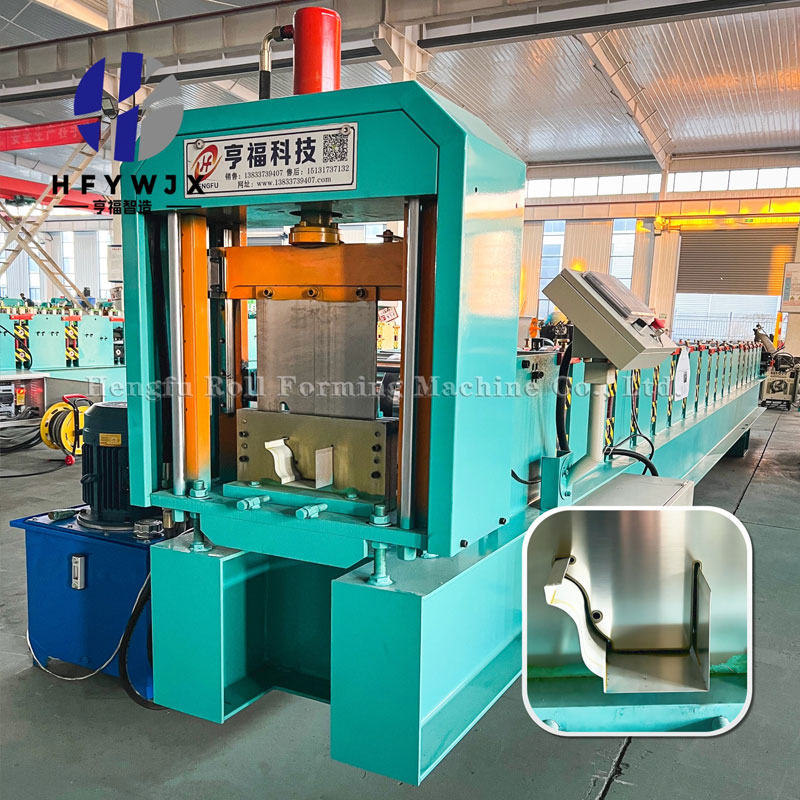
The same principle applies to downspouts and downpipes: round, square and rectangular sections formed continuously from coil, cut to the length each elevation actually requires rather than to a stock length.
Seamless vs Sectional Gutter: What the Machine Changes
| Factor | Seamless roll formed gutter | Sectional (pre-cut) gutter |
|---|---|---|
| Joints along a run | None except at corners | One every stock length |
| Leak risk | Low | Higher — every joint is a potential leak |
| Length waste | Cut to elevation, minimal offcut | Offcuts on most elevations |
| Transport | Formed on site or at the yard | Long lengths are awkward to transport |
| Colour matching | From the same coil batch as the roof | Stock colour may not match |
Profiles a Gutter Machine Should Cover
Half-round gutter — the classic profile for heritage and residential work; also supplied as beaded half-round.
Square / box gutter — higher capacity in the same width; common on commercial buildings.
K-style / ogee gutter — the volume residential standard in several export markets.
Round downpipe — formed and seam-locked, typically from the same coil.
Square and rectangular downspout — for architectural elevation work.
Flexibility matters commercially: a supplier who can offer half-round and square from one machine wins projects a single-profile competitor cannot quote.
Machine Configuration
A downspout roll forming machine or gutter line comprises:
Decoiler — usually light-duty, sized for 0.4–0.8 mm painted coil.
Feeding and guiding section — with edge protection to avoid coating damage.
Forming host — progressive passes; half-round needs more passes than box.
Beading / seaming station — optional, for stiffened front lips and locked seams.
Cut-to-length shear — PLC controlled, typically post-forming.
Run-out support — critical for long gutter lengths that must not sag before handling.
On-site machines: portable gutter formers towed to the job are a mature market segment. If your business model is installation rather than distribution, a portable machine is usually the better investment than a factory line.
Core Performance Factors
| Factor | Why it matters |
|---|---|
| Roll finish | Gutter is highly visible; any roll marking on painted coil is a reject |
| Profile symmetry | Asymmetric half-round sits awkwardly on brackets and pools water |
| Cut squareness | Out-of-square cuts leave gaps at corners and outlets |
| Length accuracy | Seamless runs are measured on site; accuracy avoids re-cuts at height |
| Material range | Painted steel, galvanised, aluminium and copper-look finishes |
| Run-out support | Long lengths deform before they cool or are handled |
Material Selection by Environment
Pre-painted galvanised steel — the volume choice; specify PVDF or HDP where colour retention is required.
Aluminium — coastal and high-corrosion environments; lighter and easier to handle at height.
Galvanised steel (Z275) — utility and agricultural buildings where appearance is secondary.
Stainless steel — architectural and aggressive industrial environments.
Match the gutter material to the roof material. Mixing metals on one building creates galvanic corrosion, and the gutter — being the wettest component — fails first.
What to Specify Before Ordering
Six checks:
Which profiles you must supply: half-round, square / box, K-style, round or square downpipe.
Material and thickness range — commonly 0.4–0.8 mm.
Whether the machine is factory-fixed or portable for on-site work.
Cut type and length tolerance.
Whether a beading or seaming station is required.
Run-out table length — specify for your longest standard run.
Operating and Maintenance Reality
The dominant defect on gutter lines is coating damage, not dimensional error. Keep rollers polished and clean, inspect the feed guide for burrs weekly, and never run coil with a damaged edge through a finished machine. Keep a spare blade set; a blunt shear on painted coil produces a visible lip at every cut end.
Future Trends
Two trends drive specification. Colour-matched rainwater systems are increasingly requested as part of a single building package, which favours in-house production from the same coil batch. And higher-capacity profiles are being driven by more intense rainfall events in many regions, pushing demand toward box and deep half-round sections rather than shallow decorative profiles.
Frequently Asked Questions
Q: Can one machine make both gutters and downpipes?
They are separate roller sets, but many suppliers specify both. Round and square downpipe sections can usually be produced on a compact companion machine sharing the same control platform.
Q: What thickness of coil is used for gutters?
Commonly 0.4-0.8 mm in pre-painted galvanised steel, aluminium or galvanised coil. Thicker material is used for commercial box gutter and for long unsupported runs.
Q: Is portable on-site gutter forming available?
Yes. Portable machines towed to the job site are standard in the installation market and eliminate transport damage on long lengths.
Q: How is a seamless gutter cut to length?
The PLC controls cut length from an encoder; the operator enters the measured elevation length and the line produces and cuts in one cycle.
Q: Which profile suits coastal environments?
Aluminium is preferred in coastal and high-corrosion environments, both for corrosion resistance and for easier handling at height. It must not be mixed with steel components on the same building.