


Floor Deck Roll Forming Machine: Composite Metal Decking for Faster Structural Cycles
writer:优化 release time:2026-11-01 13:16:09 Views:131frequency
Buying a floor deck roll forming machine is rarely about the deck itself. It is about compressing the structural cycle on multi-storey projects — the deck is the component that lets concrete pours proceed without traditional formwork, and every day saved on a floor cycle is worth more than the margin on the steel.
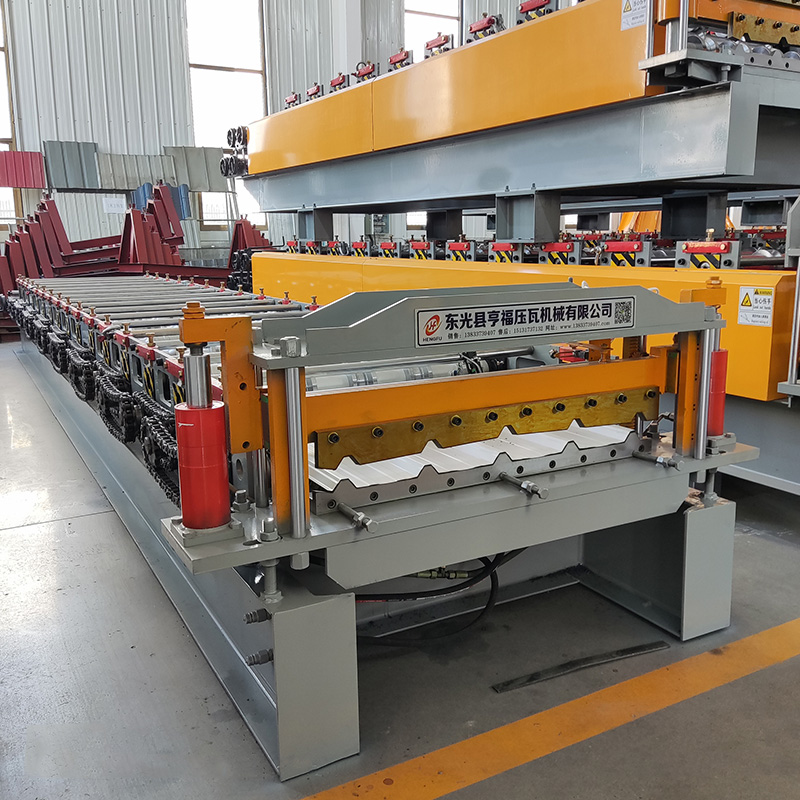
That is why floor deck is one of the most specification-driven products in roll forming. The profile must satisfy a structural engineer's composite-action calculation, not just a buyer's price comparison, and the machine must reproduce that profile accurately enough for the calculation to remain valid.
What Composite Metal Deck Actually Does
Composite floor deck performs two roles. During construction it is permanent formwork, carrying wet concrete and construction load without temporary support in many spans. In service it acts as tensile reinforcement for the concrete slab, working compositely through embossments rolled into the sheet and through shear studs welded through the deck to the supporting beams.
Because the deck is structural, the profile is specified by rib height, rib pitch, cover width and sheet thickness — and any deviation from the specified geometry reduces the load capacity the engineer assumed.
Profile Types and Where They Are Used
| Profile type | Characteristics | Typical application |
|---|---|---|
| Closed / re-entrant deck | Deep trapezoidal or dovetail ribs with a narrow opening | Composite slabs where maximum shear bond and fire rating are required |
| Open trapezoidal deck | Standard trapezoidal ribs, simpler to form | General composite slabs, mezzanines, industrial floors |
| Deep deck (long span) | Rib depth 75 mm and above | Long spans with minimal or no temporary propping |
| Roof deck / non-composite | Shallower profile | Structural roof deck where no composite action is required |
Why Embossment Is the Critical Feature
Composite action depends on the embossments — the raised indentations rolled into the rib faces that mechanically lock sheet to concrete. Embossment height, spacing and pattern are specified by the deck design, and the machine must reproduce them consistently across the full sheet width.
Engineering note: embossment is created by a dedicated embossing station or by shaped rolls in the forming passes. Worn rolls produce shallow embossments, and shallow embossments reduce composite bond — a defect that is invisible at delivery and only appears in a load test.
Core Performance Factors
| Factor | Why it matters for decking |
|---|---|
| Rib height and pitch accuracy | Structural capacity is calculated from geometry; deviation invalidates the design assumption |
| Embossment consistency | Determines composite shear bond with the concrete |
| Cover width accuracy | Decides how many sheets cover a floor and whether side laps seat |
| End-squareness | Out-of-square sheets leave gaps at beam supports and at edges |
| Thickness range | Typically 0.8–1.5 mm galvanised; the drive must handle the top of the range |
| Cut-to-length | Decking is ordered to span length; inaccurate length means site cutting |
Material and Coating Specification
Hot-dip galvanised steel, Z275 or higher — the standard specification for internal floor deck.
Galvanised coating weight — confirm against project durability requirements; heavier coating is specified for exposed or humid conditions.
Yield grade — commonly Q235 / Q345 or equivalent to the design standard used on the project.
Thickness — confirm the design thickness, not just the nominal gauge; deck is specified by design thickness in many standards.
What to Specify Before Ordering
Seven items to confirm:
Deck profile drawing with rib height, pitch, cover width and design thickness.
Embossment pattern specification and how it is produced on the line.
Material grade, coating weight and thickness range.
Required output and whether the line must run continuous shifts.
Cut type and length tolerance — decking is ordered to span.
Whether shear stud compatibility has been confirmed with the deck design.
Commissioning scope, including trial production and dimensional inspection report.
Quality Control That Protects the Design Assumption
Establish a first-piece inspection routine at the start of every coil and every thickness change: measure rib height, pitch, cover width, sheet length and end squareness, and log the results. Keep embossment height in the inspection schedule — it is the dimension most likely to drift as rolls wear and the one least likely to be noticed by eye.
Future Trends
Three developments shape this segment. Deeper profiles are being specified to eliminate temporary propping and shorten floor cycles. Higher-strength steel reduces sheet thickness for the same capacity, which raises forming force requirements. And documented dimensional inspection is being demanded by main contractors as standard, which favours suppliers who can produce inspection data per batch rather than per project.
Frequently Asked Questions
Q: What thickness of steel does a floor deck machine form?
Floor deck is typically formed from 0.8-1.5 mm hot-dip galvanised steel. The drive and frame must be specified for the top of the range, since design thickness often sits above nominal gauge.
Q: Why is embossment so important?
Embossments mechanically lock the sheet to the concrete and create composite action. If they are too shallow, the composite bond falls below the value assumed in the structural design.
Q: Can one machine produce more than one deck profile?
Each profile requires its own roller set. Fabricators running two high-volume deck profiles usually specify a second roller set rather than a second machine.
Q: What coating is specified for floor deck?
Hot-dip galvanised coil, commonly Z275 or heavier depending on the project's durability requirement and exposure condition.
Q: How accurate must sheet length be?
Decking is ordered to span length. PLC encoder-controlled cut-to-length holds length within approximately 1 mm, which avoids site cutting at the beam supports.