

Complete Guide to Roll Forming Machines: Process, Types, and Selection
writer:fdcf9e6 release time:2026-11-07 16:59:13 Views:67frequency
Roll forming is one of the most efficient metal fabrication processes for producing long, uniform cross-sectional profiles at high volume. From roofing sheets and wall cladding to structural purlins, cable trays, door frames, and custom architectural trim, roll forming machines are the backbone of the global metal manufacturing industry. This guide explains how roll forming works, the key machine types, critical selection factors, common defects and fixes, and the maintenance practices that keep a line productive for decades.
1. What Is Roll Forming?
Roll forming is a continuous cold forming process in which a flat metal strip is gradually bent into a desired profile as it passes through a series of consecutive roller stands. Each stand performs a small incremental bend, and the cumulative effect produces the final shape. Unlike press braking, which forms one piece at a time, roll forming operates continuously — coil feeds through at constant speed and finished profiles emerge at the output cut to programmed length.
The process works with cold-rolled and hot-rolled steel, galvanized and pre-painted steel, galvalume, aluminum, stainless steel, copper, and brass. Material thickness typically ranges from 0.2mm to 6mm depending on machine capacity. Product length is effectively unlimited, constrained only by coil size and output table length. Because it is a cold process, work hardening in the bent regions can increase yield strength, but very hard materials need more stations and larger bend radii to avoid cracking.
2. The Roll Forming Process Step by Step
Step 1: Uncoiling
A metal coil is loaded onto an uncoiler, which holds it and feeds the strip into the line at controlled tension. Small operations use manual uncoilers; high-production lines use hydraulic uncoilers with automatic tension control and coil cars. Typical coils weigh 1–5 tons, with heavy-duty units handling 10 tons or more. Too much tension stretches the strip, while too little lets the coil overrun and misfeed.
Step 2: Leveling and Feeding
The strip carries residual coil set and may have crossbow or edge wave. A leveler with small work rolls flattens it before forming. A servo feeder then controls precise feed length using encoder feedback, and the PLC triggers the cut-off at the programmed length. Slipping feed rolls or a dirty encoder cause length inconsistencies and waste.
Step 3: Pre-Punching (Optional)
Holes, slots, notches, or embossed features are typically punched while the sheet is still flat, before forming. Hydraulic or mechanical punches create the features, and the line either indexes for each stroke or uses a flying punch that moves with the strip. Pre-punching adds upfront cost but eliminates slow manual drilling downstream.
Step 4: Roll Forming
The strip passes through roller stands, each with top and bottom rollers on a rigid frame. Each stand adds a specific amount of bend designed using a flower pattern — a CAD overlay of the cross-section at each stage. Simple corrugated sheets need 8–12 stands, trapezoidal roofing 10–14, purlins 14–20, and complex multi-bend profiles 20–30 or more.
Rollers are machined from tool steel such as Cr12 or D2, heat-treated to 58–62 HRC, and often hard-chrome-plated for wear resistance and smooth finish. Roller design is the most critical engineering element. Poorly designed rollers cause web wandering, springback, scratching, twist, bow, oil canning, and dimensional errors.
Step 5: Cut-Off
A cut-off mechanism trims the profile to length. Stop-and-cut lines pause the feed while a hydraulic die shears; flying tracking cut-offs move with the profile at line speed, allowing continuous high-speed operation. The cut-off die is profile-specific so it supports the shape while shearing. A dull blade or poorly fitted die leaves burrs and distortion.
Step 6: Output and Stacking
Finished profiles exit onto an output table that supports them against bending. Basic machines use manual unloading; automated lines use stackers, magnetic handlers, or robotic unloaders, sometimes with automatic bundling and strapping.
3. Key Components
| Component | Function | What to Look For |
|---|---|---|
| Machine Frame | Holds all roller stands in alignment | Heavy welded steel, stress-relieved, machined surfaces |
| Roller Dies | Form the metal into final profile | Tool steel, hardened, ground, chrome-plated option |
| Drive System | Powers rollers at synchronized speed | Gear motor with reducer, adequate torque |
| Control System | Controls speed, length, punching, cut-off | PLC with touchscreen HMI, recipe storage |
| Cut-Off System | Shears profile to length | Hydraulic die, flying tracking option |
4. Types of Roll Forming Machines
4.1 Roofing Sheet Machines
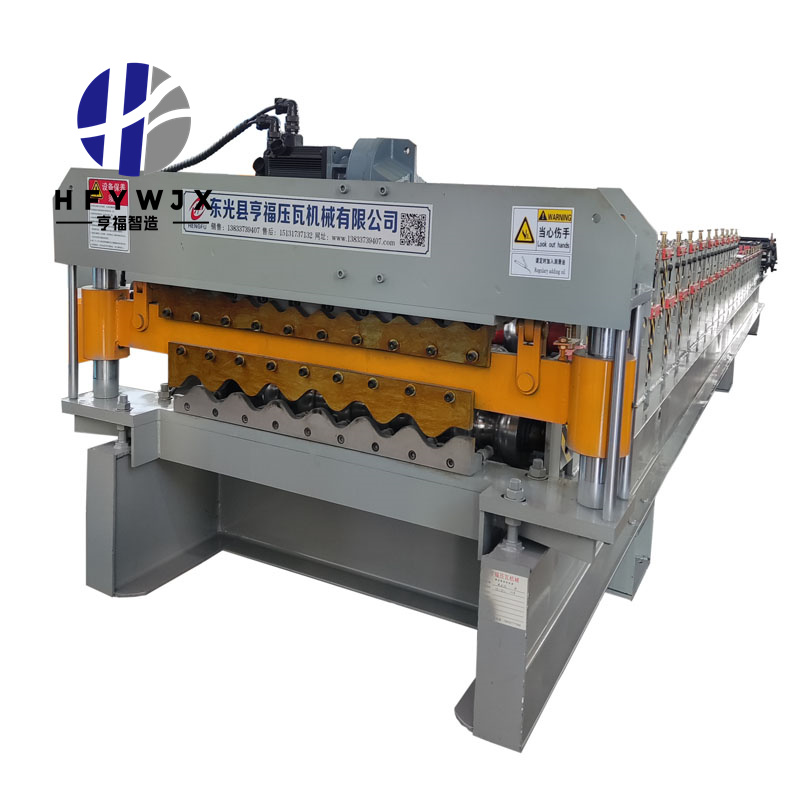
These produce corrugated, trapezoidal (IBR), and tile-effect sheets for residential, commercial, and industrial buildings. They are the most common roll forming machines, running at 15–30 m/min on 0.3–0.6mm pre-painted coil. Double-layer machines stack two roller sets vertically to produce two profiles on one line, saving floor space and investment.
4.2 C/Z Purlin Machines
Purlin machines produce structural C and Z channels for steel-framed buildings, handling 1.5–4.0mm galvanized steel with heavier frames and higher-torque drives. Manual machines take 1–2 hours to change sizes; automatic quick-change machines adjust in 5–10 minutes via servo or hydraulic positioning.
4.3 Cable Tray Machines
These produce solid bottom, perforated, ladder, and channel trays for cable management in buildings, data centers, and industrial plants. Perforated tray machines include integrated punching for ventilation holes; ladder tray machines form side rails and incorporate rungs.
4.4 Door Frame and Window Frame Machines
Door frame machines produce steel jambs and heads, usually with pre-punching for hinge, lock, and fixing holes. Adjustable-width lines produce multiple door sizes without changing roller dies. Material is typically 0.8–1.5mm painted or galvanized steel.
4.5 Downspout and Gutter Machines
Gutter machines form half-round or K-style gutters; downspout machines roll flat sheet into round or rectangular lock-seam pipes. These compact lines are often packaged with elbow benders and notchers for complete rainwater system production.
4.6 Custom Profile Machines
For specialized applications, custom roller dies are designed from a customer's drawing using flower-pattern software, then machined and tried out until the profile meets tolerances. Existing machines can often accept new custom roller sets rather than buying a whole new line.
5. How to Choose the Right Machine
5.1 Material Type and Thickness
First define the full range of materials and thicknesses, including yield strength. Thin 0.3–0.6mm roofing sheet needs a different machine from 2–4mm structural steel — frame weight, motor power, shaft diameter, and hydraulic capacity all scale with forming force. A machine rated at your maximum thickness runs thinner gauges comfortably, but an under-specified machine will stall and wear prematurely.
5.2 Profile Complexity
Simple profiles need fewer stands and cost less; complex profiles with return flanges, hems, or embossing need more stands and more investment. Tight inside radii need more gradual stations to avoid cracking. Don't pay for stands you won't use, but don't force each stand to bend too much either, which causes springback and surface damage.
5.3 Production Volume and Automation
Low-volume job shops can use basic manual machines. High-volume multi-shift plants need hydraulic uncoilers, flying cut-offs, automatic stackers, and integrated punching. The higher upfront cost is justified by labor savings and throughput.
| Tier | Price Range | Best For |
|---|---|---|
| Basic Manual | $10,000 – $25,000 | Small workshops, startups |
| Mid-Range Automatic | $25,000 – $60,000 | Medium production, growing businesses |
| High-End Automatic | $60,000 – $150,000+ | High-volume industrial plants |
6. Common Defects and Fixes
6.1 Web Wandering
The strip drifts sideways, producing asymmetric profiles. Causes include misaligned entry guides, uneven roller pressure, unbalanced tension, or off-center coil. Re-center the entry guide, check stand gaps side to side, and verify coil centering.
6.2 Springback
Metal partially unbends after forming due to elastic recovery, especially with high-strength grades. Over-bend slightly beyond the target angle, adjust finishing stands, or add a sizing stand designed for the actual material yield strength.
6.3 Surface Scratches
Scratches cause rejects and corrosion points. They come from dirty rollers, debris, rough surfaces, or misaligned guides. Clean thoroughly, polish or replace damaged rollers, and consider protective film for painted cosmetic surfaces.
6.4 Cut Length Inaccuracy
Length variation usually traces to a slipping encoder or measuring wheel, slipping feed rolls, or cut-off timing errors. Calibrate the encoder, clean and increase feed roll pressure, and verify tracking on flying cut lines.
6.5 Twist, Bow, and Oil Canning
These shape defects come from uneven forming distribution, misaligned stands, or residual stress imbalance. Re-check alignment and gaps, balance the bend sequence, adjust the leveler, and add stiffening ribs to wide flat panels to suppress oil canning.
7. Maintenance Overview
A roll forming machine is expected to run 15–20 years or more with structured preventive maintenance. Daily checks cover oil levels, unusual noise, first-piece inspection, cleaning, and safety guards. Weekly tasks include lubrication, belt and chain tension, roller inspection, and hydraulic leak checks. Annual work includes gearbox oil changes, bearing inspection, and electrical system testing.
| Wear Part | When to Replace |
|---|---|
| Cut-off blades | When cuts become rough or burred |
| Roller bearings | When noisy, hot, or loose |
| Drive belts/chains | When stretched or cracked |
| Hydraulic seals | When leaking or pressure drops |
8. Applications Across Industries
8.1 Construction and Architecture
The largest market. Roofing, cladding, purlins, door and window frames, downspouts, gutters, decking, fencing, and trim are all roll-formed. A modern steel-framed building is assembled almost entirely from roll-formed components.
8.2 Electrical and Data Centers
Cable trays, ladders, wireways, and busway enclosures are roll-formed. The data center boom drives strong demand, as every facility contains miles of cable management infrastructure.
8.3 Automotive and Transportation
Window channels, door beams, bumper reinforcements, seat rails, and structural members are roll-formed, especially in high-strength steel. Truck and trailer bodies, containers, and rail car components also use roll-formed profiles.
8.4 Renewable Energy
Solar panel mounting rails, racking, wind turbine components, and battery storage enclosure frames are roll-formed. The repetitive long galvanized profiles in solar racking are an ideal roll forming application.
9. FAQ
- How long does a machine last? — 15–20 years or more with good maintenance. The frame outlasts many sets of bearings, belts, and roller dies.
- Roll forming vs press braking? — Press braking forms one piece at a time for low-volume custom work. Roll forming produces continuous profiles at high speed with low per-piece labor.
- Can one machine handle different thicknesses? — Yes, within a designed range, using gap adjustment. Material far outside the range needs different tooling.
- How accurate is roll forming? — Around plus or minus 0.5mm on profile dimensions and plus or minus 1mm on cut length, with tighter tolerances on precision servo lines.
- What is the lead time? — 20–35 days for standard machines, 45–90 days for custom profiles including design and tryout.
- Is special training needed? — Basic operation takes a few days; setup and troubleshooting need more. Most suppliers include on-site training and commissioning.
- Can I add custom dies to an existing machine? — Yes, if frame, shafts, drive, and hydraulics are sufficient. New roller sets are much cheaper than a whole new machine.
10. Conclusion
Roll forming is a versatile, efficient, and cost-effective process for producing long, consistent metal profiles at high volume. Choosing the right machine requires careful analysis of material, profile complexity, production volume, automation, and supplier capability. When correctly matched and supported by disciplined maintenance, a roll forming line delivers decades of reliable service and strong return on investment. The best buyers focus on engineering quality and lifecycle cost, invest in operator training, and build a genuine preventive maintenance routine.
References
- Roll Forming Handbook, 2nd Edition — Society of Manufacturing Engineers
- Metal Construction Association — Roll Forming Equipment Guide
Writer David Miller
David Miller is a mechanical engineer and technical writer with more than 14 years of hands-on experience in the roll forming and sheet metal fabrication industry. He has commissioned over 120 roll forming lines across 20 countries, covering roofing, structural purlin, cable tray, door frame, and custom profile applications. He holds a Bachelor of Engineering degree in Mechanical Design and Manufacturing, and his published work focuses on practical equipment selection, process optimization, defect troubleshooting, and lifecycle maintenance.