

Roofing Sheet Roll Forming Machines: Types and Applications
writer:fdcf9e6 release time:2026-11-10 17:23:23 Views:157frequency
Roofing sheet roll forming machines are the workhorses of the metal roofing industry. They produce the corrugated, trapezoidal, and tile-effect panels that cover millions of residential, commercial, and industrial buildings around the world. This guide takes a detailed look at the different types of roofing sheet machines, the materials and coatings they process, how production speed and output are calculated, the quality controls that matter, and the economics of investing in a roofing line. Whether you are starting a new roofing fabrication business or expanding an existing one, this article gives you the practical detail needed to make sound equipment decisions.
1. What Is a Roofing Sheet Machine?
A roofing sheet roll forming machine takes a coil of pre-painted or galvanized steel and forms it into a finished roofing panel in one continuous pass. The strip feeds through a sequence of roller stands that progressively create the desired profile, then passes through a hydraulic cut-off that shears it to the programmed length. The machine runs from a PLC control panel where the operator enters sheet length, batch quantity, and line speed, and the line then produces the full batch automatically.
Roofing panels are typically made from 0.3–0.6mm thick pre-painted galvanized steel or galvalume. The thin gauge keeps the panels light and economical, while the paint coating provides weather resistance and color. The effective coverage width of a finished sheet is usually 760–1000mm depending on the profile, and the ribs or corrugations give the thin sheet its structural stiffness so it can span across purlins without sagging.
2. Main Roofing Profile Types
2.1 Corrugated Sheets
Corrugated sheets have a continuous round wave profile and are the oldest and most economical metal roofing shape. The waves are typically 18–32mm deep with a pitch of 60–80mm. Corrugated panels are simple to form, which means fewer roller stands, high line speed, and lower machine cost. They are widely used on agricultural sheds, warehouses, factories, and budget housing, and they are also common as side wall cladding. The round profile sheds water well and has a classic industrial appearance, but it spans less stiffly than a trapezoidal rib of the same depth.
2.2 Trapezoidal (IBR) Sheets
Trapezoidal sheets, often called IBR (Inverted Box Rib) or ribbed panels, have flat-sided trapezoidal ribs separated by flat webs. The ribs are commonly 25–40mm high. Because the angular ribs are structurally efficient, trapezoidal panels are stiffer and can span further between purlins than corrugated sheets, which reduces the supporting frame cost. They are the dominant profile for commercial and industrial roofing and wall cladding and are also popular on modern residential buildings. Trapezoidal machines need slightly more stands than corrugated lines to form the sharp bends.
2.3 Tile-Effect (Glazed Tile) Sheets
Tile-effect sheets are embossed and formed to imitate traditional clay or concrete roof tiles. They are a premium decorative product used on residential and upscale projects. The machine includes embossing rollers that stamp the tile pattern into the sheet, followed by forming stands that create the stepped profile. Because embossing and the complex shape slow the process, tile-effect lines run more slowly than corrugated or trapezoidal machines. The finished panels deliver the classic tile appearance at a fraction of the weight and installed cost of real tile.
3. Profile Comparison Table
| Profile | Rib Depth | Line Speed | Main Application |
|---|---|---|---|
| Corrugated | 18–32mm | 20–30 m/min | Agricultural, warehouses, budget housing |
| Trapezoidal (IBR) | 25–40mm | 15–25 m/min | Commercial, industrial, long spans |
| Tile-effect | Stepped tile | 10–15 m/min | Residential, premium decorative roofing |
4. Materials and Coatings
4.1 Steel Substrates
Most roofing panels start with galvanized steel, coated with zinc for corrosion protection, or galvalume, coated with an aluminum-zinc alloy that offers better heat resistance and long-term corrosion performance. The coating weight is specified in grams per square meter — common values are Z80, Z120, and Z180 for galvanized, with higher weights giving longer life in harsh environments. The substrate grade and thickness determine the panel's strength and formability.
4.2 Paint Systems
Pre-painted coil has a layered paint system over the metal: a primer plus a topcoat of polyester, silicone-modified polyester (SMP), or polyvinylidene fluoride (PVDF). Polyester is the cheapest and most common but fades faster in strong sun. SMP offers better durability and chalk resistance at a moderate price. PVDF is the premium finish, with exceptional color retention and weathering life of 30 years or more, used on high-end and long-life buildings. Paint film thickness is typically 20–25 microns on the top surface.
4.3 Color and Aesthetic Options
Pre-painted coil is available in a broad color range — whites, greys, reds, blues, greens, browns, and custom matched colors. Popular choices vary by region, with terracotta and earth tones common for residential and grey or white dominant in industrial buildings. Some suppliers offer wood-grain or special textured finishes. Choosing good-quality paint matters because fading and chalking are among the most visible long-term complaints on metal roofs.
5. Key Machine Components in Detail
5.1 Uncoiler
Roofing lines commonly use a 3-ton or 5-ton manual or hydraulic uncoiler. A hydraulic uncoiler with a coil car speeds up coil changes and reduces manual handling, which matters when lines run through many coils per week. The uncoiler includes a brake or tension system to stop the coil from over-running when the line pauses.
5.2 Forming Stands
A roofing mill has 8–16 forming stations depending on profile depth and complexity. Each station has hardened steel rollers on shafts supported by bearings in the frame. The stands are driven together through a gearbox, universal joints, or chain so all rollers turn at the same synchronized speed. Heavy, rigid stands prevent deflection under load, which is what preserves dimensional accuracy at high speed.
5.3 Cut-Off and Hydraulics
A hydraulic flying cut-off with a profile-shaped die shears panels to length while tracking line speed. The hydraulic power pack also drives the uncoiler and any punching. The cut-off blade must be kept sharp; a worn blade produces a burred or distorted end that installers notice immediately. Good machines give clean, square cuts with minimal end distortion.
5.4 Control Panel
The PLC and HMI are the operator's main interface. The panel stores recipes for different products, displays batch count and line status, and includes safety interlocks. Recognized PLC brands and well-labeled electrical cabinets make fault finding much easier over the machine's life. Length is set in millimeters and the encoder measures material travel to trigger each cut.
6. Double Layer Roofing Machines
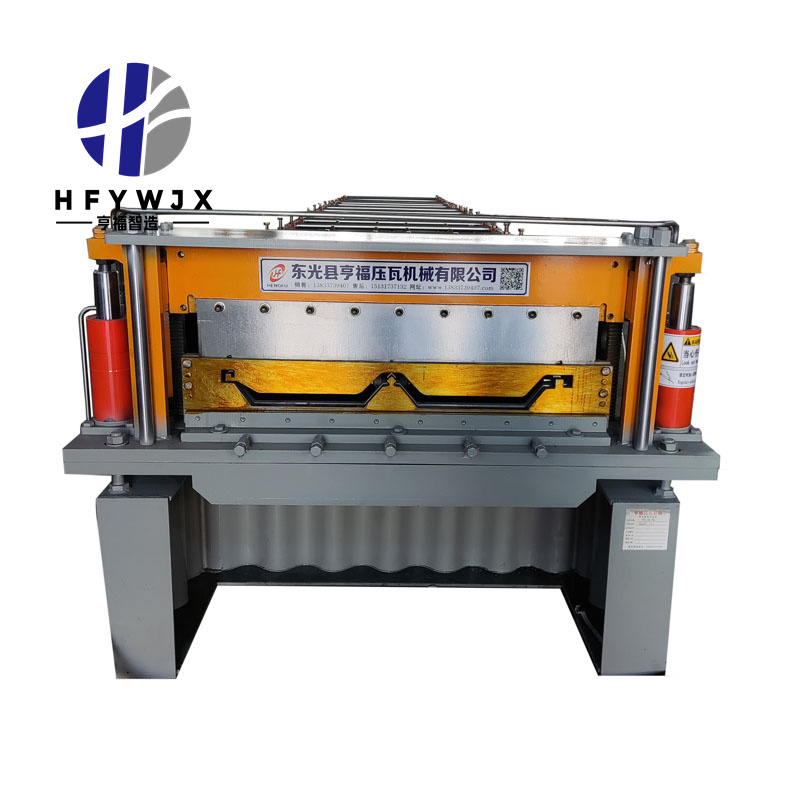
A double layer roofing machine stacks two independent roller sets, one above the other, so one line can produce two profiles. The most popular combination is corrugated on one layer and trapezoidal on the other, covering the two highest-volume industrial profiles. The uncoiler, drive, cut-off, and control system are shared, and the operator selects which layer is engaged.
The main advantage is value and floor space: a double layer costs only modestly more than a single layer but far less than two separate machines, and it occupies roughly one machine's footprint. The trade-off is that only one layer runs at a time, and there is a short changeover between profiles. For small and medium fabricators serving a mixed market, a double layer is often the most efficient starting investment.
7. Speed, Output, and Capacity Planning
Output depends on line speed, profile, and how much time is lost to coil changes and setup. A corrugated line running at 25 m/min produces 1500 meters per hour in pure running time. In practice, allowing for coil changes, cut-offs, and handling, a well-run single-shift operation might realistically achieve 8000–12000 meters of finished panel per shift over a full day. Tile-effect lines are slower because embossing limits speed.
When planning capacity, consider coil weight and changeover frequency. A 5-ton coil of 0.4mm steel contains roughly 1600 meters of strip, so a fast line consumes a coil in around an hour of running time. Efficient coil handling, enough output table space, and a second operator for stacking all help keep the line running rather than waiting.
8. Quality Control and Common Defects
8.1 Dimensional and Length Checks
The first panel of every batch should be measured for effective width, rib depth, and cut length. Length drift usually points to encoder or feed issues, while width variation suggests wandering or roller pressure problems. Catching these at the first piece prevents a whole batch of rejects.
8.2 Surface and Paint Damage
Scratches on the painted face are a major reject cause. They come from debris on rollers, misaligned guides, or a dragging cut-off. Keeping rollers clean, fitting smooth entry guides, and using protective film on high-end coil all protect the finish. The cut edge should be clean without burrs that could cut installers.
8.3 Profile Shape and Oil Canning
Wide flat webs are prone to oil canning — visible waviness under light. Stiffening ribs in the web, correct roller adjustment, and properly leveled material all reduce it. Rib angles should be consistent along the panel so adjacent sheets overlap and seal correctly on the roof.
9. Investment Cost and Economics
| Configuration | Indicative Cost | Suitable For |
|---|---|---|
| Single-layer basic | $12,000 – $20,000 | Startup, single-profile production |
| Double-layer automatic | $18,000 – $30,000 | Small-mid fabricators, mixed profiles |
| High-speed full line | $35,000 – $70,000 | High-volume multi-shift plants |
Beyond the machine, budget for tooling, spare parts, the first coil inventory, workshop space, and handling equipment such as a crane or forklift. The business model works on volume and material margin: fabricated panels sell at a premium over raw coil, and a line that stays busy with local construction demand can recover its investment within a few years. Offering fast turnaround, custom cutting, and delivery strengthens margins against larger competitors.
10. Installation and Site Considerations
The machine needs a level, solid concrete floor strong enough for a heavy line and long output tables, plus adequate power supply and workshop height for coil loading. Leave clearance on the uncoiler side for coil delivery and at the output end for the longest panels you plan to produce. Commissioning includes leveling the machine, running test material, calibrating the encoder, and training operators. Proper installation prevents alignment problems that are hard to correct later.
11. Market Trends
Demand for metal roofing continues to grow as metal panels gain share over traditional asphalt and tile, driven by durability, light weight, fire resistance, and recyclability. Pre-engineered metal buildings are expanding in industrial and logistics construction, and energy-efficient cool-roof coatings are increasingly specified. For fabricators, the trend supports ongoing demand for both standard structural profiles and premium decorative tile-effect panels, making a flexible double-layer or multi-profile line well aligned with the market.
12. FAQ
- How fast does a roofing machine run? — Corrugated lines reach 20–30 m/min, trapezoidal around 15–25 m/min, and tile-effect about 10–15 m/min because embossing slows the process.
- What thickness is standard? — 0.3–0.6mm pre-painted steel, with 0.4–0.5mm the most common balance of cost and stiffness.
- Can one machine make several profiles? — A double-layer machine produces two profiles on stacked roller sets. A single-layer machine is dedicated to one profile.
- How long does a metal roof last? — With quality paint, 30–50 years. PVDF finishes significantly outlast cheap polyester in color retention and weathering.
- Is manual or hydraulic uncoiler better? — Hydraulic uncoilers speed coil changes and reduce labor for high throughput; manual uncoilers are adequate for small, low-volume operations.
- What causes oil canning? — Stress and lack of stiffness in wide flat webs. Stiffening ribs, correct leveling, and roller adjustment reduce it, though it cannot always be eliminated completely.
- Is roofing fabrication profitable? — Yes, with steady construction demand, good material margins, and value-added services such as custom cutting and fast local delivery.
13. Conclusion
Roofing sheet roll forming machines are productive, relatively accessible equipment that turns coated coil into finished roofing panels in a continuous automated process. The key choices are the profile mix — corrugated, trapezoidal, or tile-effect — the material and paint quality, and the automation level. Small and medium businesses often get the best start with a double-layer line covering two high-demand profiles, while high-volume plants invest in fast fully automatic lines with hydraulic handling. Focus on build quality, clean cutting, operator training, and realistic capacity planning, and a roofing line will be a reliable, profitable asset for many years.
References
- Metal Construction Association — Metal Roofing Systems Design Manual
- Roofing Contractor Magazine — Roll Forming Equipment Buying Guide
Writer John Anderson
John Anderson is a mechanical engineer and technical writer with more than 14 years of hands-on experience in the roll forming and sheet metal fabrication industry. He has commissioned over 120 roll forming lines across 20 countries, covering roofing, structural purlin, cable tray, door frame, and custom profile applications. He holds a Bachelor of Engineering degree in Mechanical Design and Manufacturing, and his published work focuses on practical equipment selection, process optimization, defect troubleshooting, and lifecycle maintenance.